
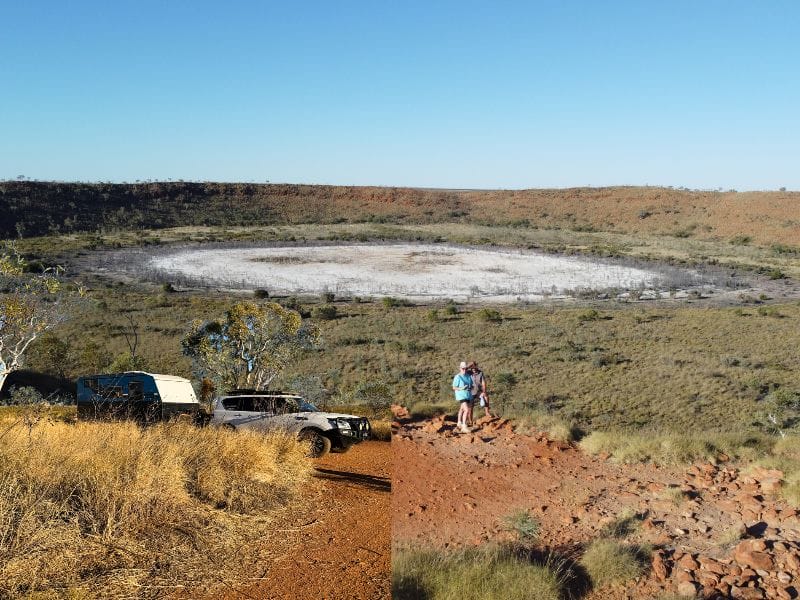
After spending time exploring Kununurra and the surrounding area, it was time to point the Patrol and caravan south towards Halls Creek and the start of our Tanami Track adventure. Our plan was to visit Wolfe Creek Crater before continuing across the Tanami Desert towards Alice Springs.
Rather than drive all the way to Halls Creek in one day, we stopped overnight at the Spring Creek Rest Area, near the turn-off to the Bungle Bungles. The following morning, we continued to Halls Creek to fill the Patrol and our three jerry cans before heading off the bitumen.
In this article, we share our experience travelling from Kununurra to Wolfe Creek Crater, including where we camped, what the road conditions were like towing our caravan and what you need to know if you’re considering this trip yourself.
Watch Our Kununurra to Wolfe Creek Crater Adventure
Join Kev and I as we leave Kununurra, travel through the East Kimberley and begin our journey along the Tanami Track. We share our overnight camping spot, fuel preparations in Halls Creek, road conditions and what it’s like towing a caravan into Wolfe Creek Crater.
If you’re considering travelling the Tanami Track yourself, this episode will give you a firsthand look at what to expect along the first section of the journey.
Kununurra to Spring Creek Rest Area
Before leaving Kununurra, we made one last stop at the camping shop to buy another jerry can, bringing our total to three. With some fairly expensive fuel ahead of us along the Tanami Track, we wanted to carry enough extra petrol to give us some flexibility between fuel stops.
We were still experiencing electrical problems with both the Patrol and the caravan following our Gibb River Road adventure. However, with our water tanks and batteries fully charged, we decided to continue with our plans to travel the Tanami Track. Unlike the Gibb, where we’d spent several days at a time exploring the gorges, we planned to make overnight stops as we travelled towards Alice Springs.
Taking the Tanami Track would also cut around 500km off our journey compared with travelling via Katherine and the Stuart Highway, although with remote fuel prices, we weren’t convinced we’d save much money.
Why We Skipped the Bungle Bungles
We had considered visiting Purnululu National Park, home to the famous Bungle Bungle Range, but after speaking with other travellers in Kununurra, we decided to leave it for another trip. Plus we were heading home to Queensland to surprise my son for his birthday in mid July.
We’d heard reports of particularly rough road conditions, including stories of experienced four-wheel drivers who had already completed the Gibb River Road turning back. Interestingly, when we reached Spring Creek Rest Area, we heard quite different accounts. Some travellers said it had taken them four hours to drive into the national park, while others had made it to the ranger station in around an hour.
Road conditions can change considerably throughout the season, and everyone’s experience and comfort level on rough tracks are different. After our adventures on the Gibb, we were happy to save the Bungle Bungles for another time.
Free Camping at Spring Creek Rest Area
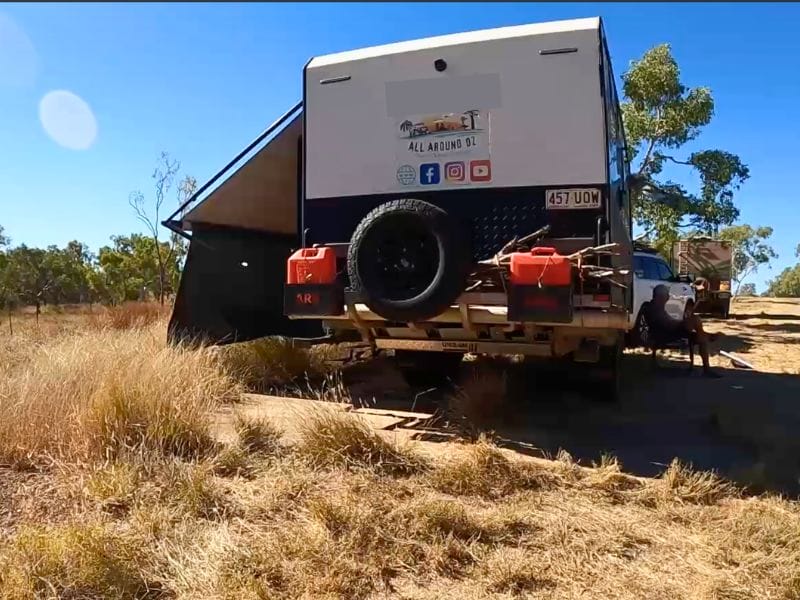
Spring Creek Rest Area is a free 24-hour overnight camping spot on the Great Northern Highway, near the turn-off to Purnululu National Park. It’s a popular stop for travellers between Kununurra and Halls Creek, particularly those visiting the Bungle Bungles.
When we arrived in late June, the rest area was already quite busy. The closure of the Bungle Bungle Caravan Park earlier that month meant there were plenty of travellers using the rest area as a base.
We managed to find a level spot on what appeared to be an old concrete slab, which meant Kev didn’t even need to adjust the caravan’s airbags. It was also out in the open, which suited us perfectly as we were still trying to maximise our solar charging.
Spring Creek Rest Area Facilities
- Free overnight camping with a 24-hour limit
- Toilets
- Dump point
- Rubbish bins
- Shaded and open camping areas
- Space for caravans and larger rigs
The rubbish bins were overflowing when we visited, so it’s worth being prepared to take your rubbish with you.
Despite being camped quite close to the highway, we didn’t hear any trucks overnight. There’s a lovely little creek alongside the rest area, and we spotted a bowerbird while having a wander around.
Our tip: If you’re relying on solar power, try to arrive early enough to secure a spot away from the trees, particularly during the busy Kimberley dry season.
For a free overnight stop between Kununurra and Halls Creek, Spring Creek Rest Area suited us well, and we’d happily stay there again.
Refuelling in Halls Creek Before the Tanami Track
After a quiet night at Spring Creek Rest Area, we continued south towards Halls Creek. Along this stretch of the Great Northern Highway, we saw more wedge-tailed eagles than we’d seen anywhere else on our Kimberley trip. Several were feeding on roadkill, and there was also plenty of cattle wandering near the road, so keep an eye out as you drive through here.
Halls Creek was our last major fuel stop before heading onto the Tanami Track. We’d already checked PetrolSpy and discovered that unleaded petrol at Billiluna was around $3.70 a litre at the time of our trip. Our plan was to fill the Patrol and all three jerry cans in Halls Creek and only top up at Billiluna if necessary.
We spent $350 filling the Patrol and our three jerry cans. Fuel prices in Halls Creek were quite reasonable considering its remote location.
Fuel is one of the biggest expenses when travelling around Australia, particularly if you’re towing a caravan. We’ve shared more about our travel expenses in How Much Does a Lap of Australia REALLY Cost?
Stopping in Halls Creek
We initially stopped at the BP, but its unleaded petrol pump wasn’t working, so we were directed to the Shell service station. Before we left, the attendant advised us to keep our vehicle locked, which we did.
The service station had a selection of basic groceries, fresh fruit and vegetables and ready-made sandwiches. However, we’d recommend doing your main grocery shop in Kununurra before setting off.
Preparing for the Tanami Track
Before leaving Halls Creek, make sure you’ve checked the following:
- Fuel levels and spare fuel capacity
- Drinking water and caravan water tanks
- Tyre condition and spare tyres
- Food and essential supplies
- Current road conditions and fuel availability
- Emergency communications, particularly outside mobile phone coverage
Fuel availability and prices can change in remote communities, so it’s worth contacting the roadhouses directly before setting off rather than relying solely on fuel apps.
With the Patrol and jerry cans full, we were ready to turn onto the Tanami Road and make our way towards Wolfe Creek Crater.
Tanami Track Road Conditions: Halls Creek to Wolfe Creek Crater
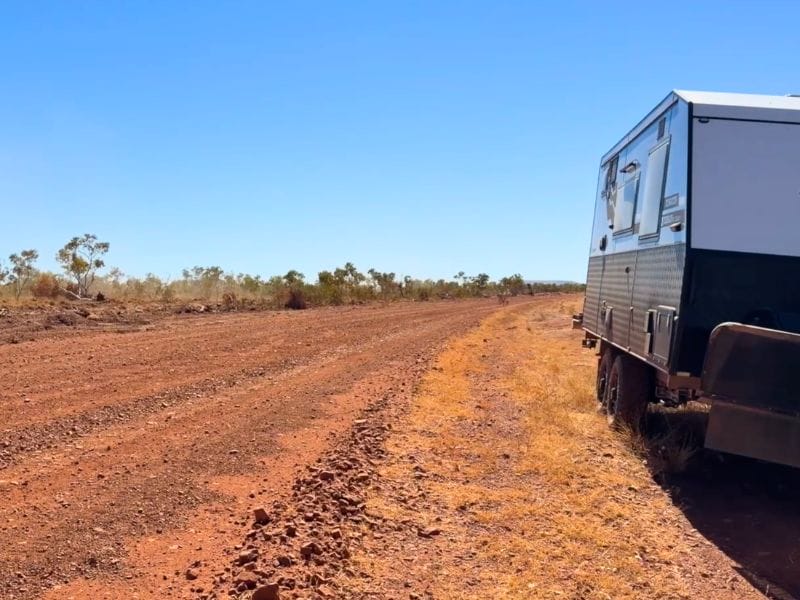
The turn-off onto the Tanami Road is just south of Halls Creek. When we travelled through in June, there was a considerable amount of roadwork underway, with sections of bitumen and recently graded gravel.
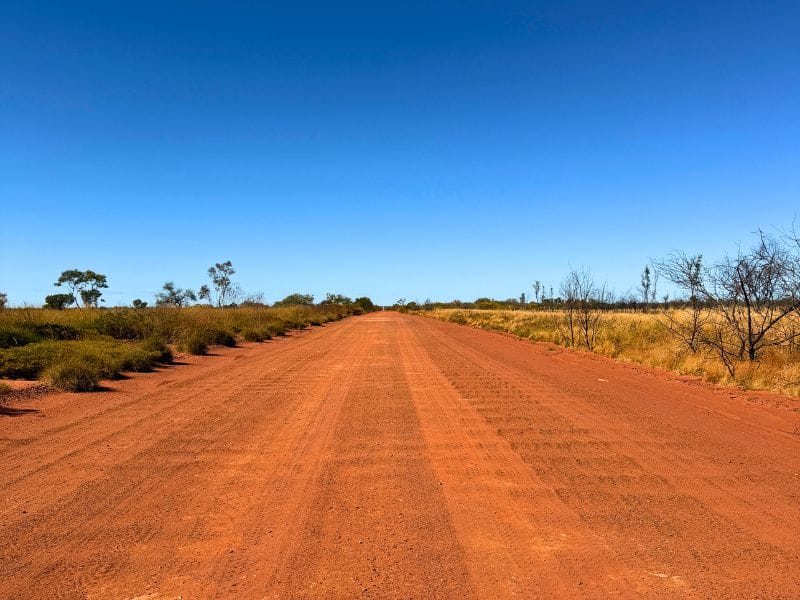
Once the bitumen ran out, the road gradually became rockier, with a few bumps and corrugations. Kev stopped to reduce the tyre pressures to 30 PSI to see how the Patrol and caravan handled the conditions. Of course, the correct tyre pressures for your setup will depend on your vehicle, tyres, weight and road conditions.
There wasn’t much traffic along this section of the Tanami Track. We passed just a couple of caravans heading back towards Halls Creek, and the landscape was already beginning to feel quite remote.
Driving into Wolfe Creek Crater with a Caravan
We’d been told by fellow travellers at Spring Creek Rest Area that the grader had recently been through the access road to Wolfe Creek Crater. Thankfully, they were right, and we had a relatively smooth drive into the campground.
After some of the rough roads we’d experienced along the Gibb River Road, it was a welcome change!
Wolfe Creek Crater is approximately 145km from Halls Creek. While we found the access road quite manageable with our off-road caravan, conditions can deteriorate between grading, particularly during periods of heavy traffic or following rain.
If you’re planning to tow a caravan into Wolfe Creek Crater, check the latest road conditions before leaving Halls Creek, drive to suit the conditions and allow yourself plenty of time. It’s also worth asking travellers coming from the opposite direction about their recent experience, as we did at Spring Creek.
Camping at Wolfe Creek Crater
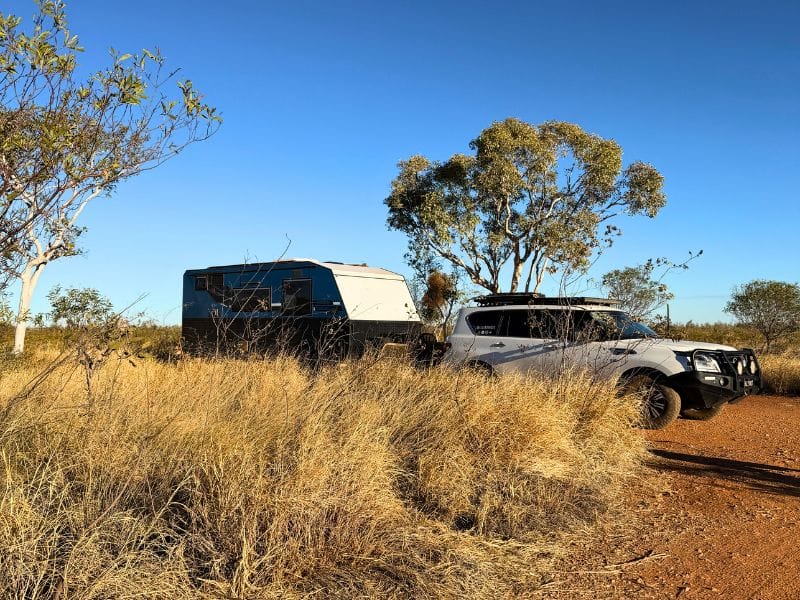
We planned to spend one night at the Wolfe Creek Crater campground before continuing along the Tanami Track towards Alice Springs. After setting up the caravan, we walked approximately 800 metres from the campground to the crater, which made it an easy spot to base ourselves for the afternoon.
The campground has a lovely remote outback feel, surrounded by red dirt, spinifex and native vegetation. It’s also a great spot to enjoy the night sky, with very little light pollution.
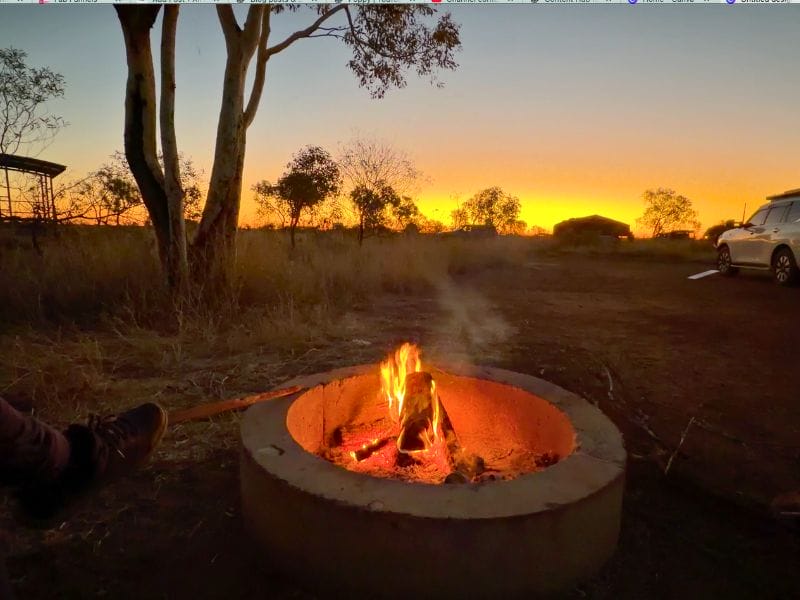
When we visited in June, campfires were permitted in designated fire rings. However, seasonal fire restrictions apply, so check the current WA Parks advice before lighting a campfire.
Exploring Wolfe Creek Crater (Kandimalal)
After setting up camp, we wandered over to the crater, stopping to read the information boards before tackling the climb to the rim. It’s fascinating to think that a meteorite could have created something of this size in the middle of the Australian outback.
One of the things I love most about the outback is the contrast of colours. The deep red earth against the green vegetation and creamy-coloured spinifex is such a quintessential Australian landscape. As much as we love being near the ocean, there’s something special about this part of the country, too.
Walking to the Wolfe Creek Crater Rim
The walk to the crater rim is approximately 400 metres return. Although it’s a relatively short walk, it’s steep and rocky in places, so wear sturdy walking shoes and take some water.
There’s also the option of walking around the crater rim, which is a Class 4 walk, with around two hours recommended to complete it. As it was already about 3 pm when we arrived, we decided against doing the entire rim walk.
Climbing down into the crater is not permitted due to the steep slopes and loose rocks. You can appreciate the sheer size of the crater from the rim, and if you’re a keen photographer, there are some wonderful opportunities to capture the surrounding landscape.
How Was Wolfe Creek Crater Formed?
According to WA Parks, Wolfe Creek Crater was formed when a massive meteorite struck the Earth around 300,000 years ago. Measuring approximately 880 metres across, it’s the world’s second-largest confirmed impact crater from which meteorite fragments have been recovered.
The crater was originally around 120 metres deep, but over thousands of years, windblown sand and sediment have gradually filled it.
Although the crater was identified by European geologists during an aerial survey in 1947, Aboriginal people had known about it long before then.
The Aboriginal Significance of Kandimalal
The Jaru people are the Traditional Owners of Wolfe Creek Meteorite Crater National Park, and the crater, known as Kandimalal, holds significant cultural importance.
Several Aboriginal creation stories are associated with the crater. One tells of two rainbow serpents travelling across the desert, with one emerging from beneath the ground to create the circular formation. Another describes a star falling from the sky and striking the Earth.
You can learn more about these stories on the information boards at the crater and on the official WA Parks website.
Wolfe Creek Crater and the Wolf Creek Movie
If the name Wolfe Creek sounds familiar, it’s probably thanks to the 2005 Australian horror movie Wolf Creek, starring John Jarratt as the rather terrifying Mick Taylor.
Interestingly, despite the movie being associated with Western Australia’s Kimberley region, most of it was filmed in South Australia, with some scenes filmed in Western Australia, including at the crater itself.
You’ll also notice that the movie title is spelt Wolf Creek, while the actual crater is spelt Wolfe Creek.
We couldn’t resist a few jokes about the movie as we drove into the campground. Thankfully, there was no sign of Mick Taylor during our overnight stay!
Is Wolfe Creek Crater Worth Visiting?
If you’re travelling the Tanami Track, Wolfe Creek Crater is definitely worth the detour. We’d recommend staying overnight rather than trying to squeeze in a visit before continuing along the track, particularly if you’re towing a caravan.
Standing on the rim gives you a much better appreciation of the sheer size of the crater than photographs ever could. The surrounding desert landscape is beautiful in its own right, particularly in the late afternoon when the sunlight brings out those rich outback colours.
For us, it was also a lovely introduction to the Tanami Desert after spending so much time exploring the gorges, waterfalls and waterways of the Kimberley.
We’re glad we included Wolfe Creek Crater in our journey, and with a free campground within walking distance of the crater, it’s an easy overnight stop to incorporate into your Tanami Track itinerary.
Wolfe Creek Crater FAQs
How far is Wolfe Creek Crater from Halls Creek?
Wolfe Creek Crater is approximately 145km from Halls Creek via the Tanami Road and Wolfe Creek Crater access road. Allow extra travelling time for unsealed sections, corrugations and changing road conditions.
Can you tow a caravan to Wolfe Creek Crater?
Yes, provided your caravan and tow vehicle are suitable for unsealed roads. We towed our off-road caravan into the campground without any problems, although the access road had recently been graded when we visited. Always check current road conditions before setting off.
Is camping at Wolfe Creek Crater free?
Yes, camping at Wolfe Creek Crater campground is free, and bookings are not required. The campground has basic toilet facilities, but you’ll need to bring your own drinking water and be self-sufficient.
Can you walk around Wolfe Creek Crater?
Yes, you can walk around the crater rim. Allow approximately two hours for this Class 4 walk. If you’re short on time, the 400-metre return walk to the rim offers excellent views across the crater.
Can you walk inside Wolfe Creek Crater?
No, climbing down into the crater is not permitted due to the steep slopes and loose rocks.
When is the best time to visit Wolfe Creek Crater?
The cooler, drier months between May and September are generally the best time to visit Wolfe Creek Crater. Summer temperatures can be extreme, and wet-season rainfall can make access roads impassable.
If you’re planning a longer trip, our guide to the best time to drive around Australia will help you work out when to visit different regions.
Is Wolfe Creek Crater on the Tanami Track?
Wolfe Creek Crater is accessed via a separate unsealed road off the Tanami Track, south of Halls Creek. It’s a worthwhile side trip for travellers crossing the Tanami Desert between Western Australia and the Northern Territory.
Is Wolf Creek based on a true story?
The 2005 Australian horror movie Wolf Creek is fictional, although it drew inspiration from real Australian crimes. The events depicted in the movie did not take place at Wolfe Creek Crater.
Continuing Our Journey Along the Tanami Track
After our overnight stay at Wolfe Creek Crater, it was time to get back onto the Tanami Track and continue our journey towards Alice Springs.
We still had hundreds of kilometres of remote outback roads ahead of us, with expensive fuel, limited facilities and some unpredictable road conditions to contend with.
In our next article and YouTube episode, we’ll share what it was like crossing the Tanami Desert with our caravan, including where we camped, where we refuelled and how we managed our fuel and power along the way.
If you’re mapping out your own Big Lap of Australia and wondering how to prepare for remote adventures like this one, our Planning a Lap of Australia ebook covers everything from choosing your setup and budgeting to preparing for life on the road.

With years of experience travelling Australia in a caravan, I’m passionate about helping others embark on their own unforgettable adventures. From off-grid camping tips to expert advice on planning the ultimate big lap of Australia, I share stories, practical hacks, and inspiration to make your journey stress-free and exciting. Whether you’re a seasoned traveller or just starting out, join me as I explore the beauty of Australia, one road at a time!
- Kununurra to Wolfe Creek Crater via the Tanami Track - 25/11/2026
- Lake Argyle and Ivanhoe Crossing: Exploring Beyond Kununurra - 11/11/2026
- Things to Do in Wyndham WA: Is It Worth Visiting? - 06/11/2026

That was a great read thankyou that’s one section of road that I will definitely be doing we’ve done the GRR & been to Ayres Rock but haven’t connected the two via the Tanami desert ,,,, So happy travels & thanks again for the great read of your trip
Thanks Gary
We’d like to the Great Central Road from Laverton to Winton at some stage. We did the Alice – Boulia leg of the Plenty Highway. Those YouTube episodes and blog posts are coming up soon
Cheers
Annette