After leaving Windjana Gorge, we were well into our Gibb River Road trip and heading towards our next base at Silent Grove.
We’d planned three nights there, which was quite deliberate. We weren’t interested in racing along the Gibb ticking off one gorge after another, so this was going to be one of our slower stops. We’d have time to explore Bell Gorge without packing up the caravan the same day, as well as a couple of afternoons where we could simply enjoy being camped in the Kimberley.
What we didn’t know was that Silent Grove was also where a problem with our caravan power system was about to become much more concerning.
Driving From Windjana Gorge to Silent Grove

After packing up at Windjana Gorge, we continued along the Gibb towards Silent Grove. One thing that surprised us along the way was coming across a couple of sections of bitumen amongst all that dirt.
We didn’t change our tyre pressures any further after leaving Windjana. We’d already aired down earlier in the trip, with the Patrol running at 25psi all round and the caravan at 30psi, and continued with those pressures.
We arrived at Silent Grove at around 1pm, found ourselves a spot and settled in for the afternoon.
Camping at Silent Grove

Dulundi (Silent Grove) Campground is about 10km from Dalmanyi (Bell Gorge), making it a very handy base if you’re travelling the Gibb River Road with a caravan.
We’d booked ahead, although once again we’d only done that shortly before arriving. There aren’t individually allocated sites, so you book an area and choose a suitable vacant spot when you get there. There’s a separate generator area and quiet area, and we found plenty of shade around the campground.
There are toilets and showers, although having our own shower in the caravan meant we didn’t use the campground showers. Non-potable water was available around the campground during our stay, but you’ll need to carry your own drinking water.
We stayed for three nights and found the campground busy but still peaceful.
For us, three nights worked really well. We arrived early afternoon and spent the rest of that day around camp, devoted the following day to Bell Gorge and then gave ourselves another full day without needing to go anywhere.
If we were doing the same trip again, I’d allow at least two nights at Silent Grove. Trying to arrive, walk Bell Gorge and leave again after one night would have felt far too rushed for us.
Current WA Parks camping fees at Silent Grove are $20 per adult per night, $15 concession and $5.50 for children aged 6–15, with park entry fees charged separately. Bookings are essential, and the campground is generally open during the dry season depending on road access.
Driving From Silent Grove to Bell Gorge
We left the caravan at Silent Grove and drove the Patrol out to Bell Gorge.
It’s only about 10km from the campground, and the road was in good condition when we visited in June 2026. There were a couple of creek crossings along the way, but nothing we found particularly difficult.
At Bell Gorge itself, there’s a parking area with toilets, picnic tables and an information shelter before you set off on the walk.
And this is where things became a little more interesting.
Walking Into Bell Gorge
The first part of the Bell Gorge walk was lovely, although there were plenty of loose stones underfoot and the terrain became progressively more challenging as we went.
We also managed to make it slightly longer than necessary.
At one point we continued straight ahead when we should have turned. There was actually a signpost with an arrow showing us exactly where to go. We just missed it.
As you’ll see in our YouTube video, this resulted in Kev being officially sacked as navigator.
Fortunately, we realised our mistake, doubled back and found the correct track.
From the car park, I’d allow somewhere around half an hour to 45 minutes to reach the falls, depending on your pace and how often you stop along the way.
How Hard Is the Bell Gorge Walk?
This is where it’s useful to understand that there are actually two parts to the Bell Gorge walk.
The Dalmanyi (Bell Gorge) Trail takes you from the parking area to above the waterfall. From there, the Dalmanyi Falls Trail continues across the top of the falls and down to the deep pool below. The entire trail is around 2km, but that extension into the gorge is the difficult part. WA Parks classifies the descent to the pool as Grade 5.
And having done it, I’d agree with that Grade 5 rating.
Getting down to the bottom was considerably harder than either the Windjana Gorge Orange Loop or Tunnel Creek, which we’d done at our previous stop. There was plenty of scrambling over large rocks, steep sections and loose footing.
For us, Bell Gorge was definitely the hardest of those three walks.
That doesn’t mean we regretted doing it. Far from it. But if you’re expecting a straightforward stroll down to a swimming hole, that’s not what we experienced.
Crossing the Water Above Bell Gorge

Before we could make our way down into the gorge, we had to cross the water a little way back from the top of the falls.
This was one of the parts that surprised me most.
In places, the water was around thigh-deep on me and approximately knee-deep on Kev. From the edge it didn’t look particularly concerning, but as soon as I stepped into the water I could feel how strong the current actually was.
I was definitely hesitant.
It was strong enough that I remember thinking it could quite easily knock a child off their feet, and quite a few people were taking their time getting across. We crossed without any problems, but it was something we treated with care rather than charging straight through.
Those were the conditions we encountered in June 2026. Water depth and flow will vary, so what we experienced shouldn’t be taken as an indication of what the crossing will be like on another day.
Getting Down to the Bottom of Bell Gorge

Once we’d crossed the water, there was a climb up over solid rock before we began making our way down into the gorge.
This was the section where the Grade 5 classification really made sense. Getting down involved scrambling over large rocks and negotiating some fairly steep terrain.
Interestingly, we actually found getting back out of the gorge easier than getting in. That’s obviously going to vary from person to person, but for us the descent required more thought and care than the climb back out.
Then you reach the bottom and see what you’ve made all that effort for.
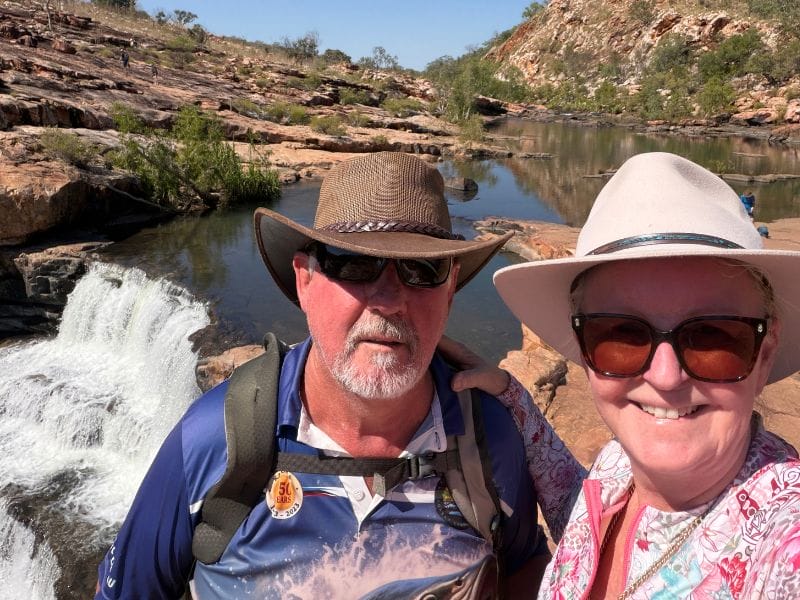
Bell Gorge is beautiful.
The waterfall drops into a large, crystal-clear pool surrounded by the gorge walls, and after the walk and scramble down, it’s a pretty impressive reward.
Swimming at Bell Gorge

Kev went swimming.
I did not.
The water at the bottom was absolutely freezing, and I’m quite happy to admit I was too much of a wuss to get in. Kev was braver than me and went for a swim while I stayed comfortably out of the water.
Even without swimming, though, it was worth making the effort to get all the way down.
By the time you allow for walking in, getting down into the gorge, spending some time at the waterfall, having a swim if you’re inclined and walking back out, I’d allow at least a couple of hours for Bell Gorge rather than trying to squeeze it into a tight schedule.
It ended up being one of our favourite gorges along the Gibb, along with Galvans Gorge later in the trip.
Watch Our Bell Gorge & Silent Grove Experience
The terrain at Bell Gorge is one of those things that’s much easier to understand when you can actually see it, particularly the water crossing and the Grade 5 section down into the gorge.
Our Episode 3 video follows the drive from Windjana Gorge to Silent Grove, our Bell Gorge walk, Kev’s brief and unsuccessful career as navigator, and the start of another problem that was developing back at the caravan.
If you’re planning to walk down to the pool yourself, the video will give you a much better idea of the terrain we encountered than I can give you with words alone.
Is Bell Gorge Worth the Walk?

For us, absolutely.
Bell Gorge ended up being one of our favourite stops on the Gibb River Road. The walk into the gorge was harder than we’d expected, but that was also part of what made finally reaching the pool at the bottom so rewarding.
I’d just go into it knowing that if you want to get all the way down to the swimming hole, you’re taking on the Grade 5 section rather than simply doing an easy walk to a waterfall.
Wear sturdy footwear, carry plenty of water and give yourself enough time that you aren’t rushing to get back to the car.
Wunaamin Conservation Park is remote 4WD country and is generally accessible during the dry season from around May to October, depending on road conditions. Temperatures can also exceed 40°C, so current park alerts and conditions are worth checking before setting out.
How Many Nights Do You Need at Silent Grove?
Based on our experience, I’d stay at least two nights if Bell Gorge is the reason you’re stopping.
That gives you time to arrive and set up without immediately rushing off to do the walk, then dedicate the following day to Bell Gorge. If you’ve got enough time in your Gibb itinerary, our three-night stay gave us something we really appreciated: a completely unplanned day around camp.
Those slower days became an important part of our trip rather than wasted time between attractions.
Unfortunately, our quiet stay at Silent Grove didn’t remain quite as relaxing as we’d expected.
When Our Caravan Power Problems Started
We’d already noticed something wasn’t quite right with our caravan power system earlier in our travels.
We’d had issues while staying off-grid at Quobba Beach and Pender Bay, particularly once we’d been camped for more than a couple of nights. At Silent Grove, on our third night, we ran out of power again.
That was concerning because we’d deliberately parked in a nice sunny spot and expected our solar to keep everything running.
Then things got stranger. When I switched the gas on, we completely lost our 12-volt power.
We spent a good couple of hours troubleshooting, trying to reset everything and work out what on earth was going on. Nothing seemed to fix it, until eventually the power came back.
One thing I hadn’t really considered until then was just how dependent we were on the 12-volt system. When we lost power, we couldn’t even use the water pump to get water from our tanks.
That’s not something you particularly want to discover while you’re travelling remotely along the Gibb River Road.
The following morning, when we were due to leave Silent Grove, we woke up to absolutely no power again.
At that point we still didn’t know what was causing the problem. All we could do was pack up and continue along the Gibb, hoping we could get it sorted.
Unfortunately, this was only the beginning of our power issues.
A Campfire Lesson From the Ranger
One morning at Silent Grove, I noticed one of the rangers pull up in her ute with a water tank and pump on the back. She started spraying water over what looked like the remains of a campfire from the night before, and as the water hit it, steam started rising from the ground.
I went over and asked whether this was a regular occurrence. She told me it was. The ranger on duty goes around checking the old campfires and putting more water on them because people often aren’t using enough water to extinguish their fires properly.
What surprised me was that from looking at it, you could easily have assumed that fire was already out. Clearly, it wasn’t.
It’s a good reminder that if you’re having a campfire, don’t just pour a little water over it and assume the job is done. Use plenty of water and make absolutely sure the fire and the ground underneath it are cold before you leave it.
This isn’t only about preventing a bushfire. Kids can walk through an old campfire area hours later and burn their feet or hands on hot coals or ground that looks perfectly safe from the surface.
There was non-potable water available at Silent Grove when we stayed, so while it wasn’t suitable for drinking, there was water available to properly extinguish a campfire. If you’re going to have a fire, please use enough of it.
Leaving Silent Grove
Our next stop was Mount Barnett Roadhouse, where we planned to continue exploring this part of the Gibb River Road.
Despite the power problems, Silent Grove and Bell Gorge had been a fantastic stop. Giving ourselves three nights meant we didn’t have to rush, Bell Gorge had earned itself a spot amongst our favourites, and we’d now experienced our first genuine Grade 5 walk of the trip.
We just had one fairly significant question hanging over us as we pulled out of Silent Grove: what on earth was going on with our caravan power?
For now, we were continuing on.
Next stop, Mount Barnett.

With years of experience travelling Australia in a caravan, I’m passionate about helping others embark on their own unforgettable adventures. From off-grid camping tips to expert advice on planning the ultimate big lap of Australia, I share stories, practical hacks, and inspiration to make your journey stress-free and exciting. Whether you’re a seasoned traveller or just starting out, join me as I explore the beauty of Australia, one road at a time!