

No visit to outback Queensland would be complete without exploring all that the wonderful Quilpie Shire has to offer.
Located in the heart of South West Queensland’s Channel Country, the Quilpie Shire also encompasses the tiny villages of Eromanga, Adavale, Toompine and Cheepie, as well as the larger town of Quilpie Qld. Covering a large area, you will have no trouble at all finding lots of things to see and do.
Quilpie Qld: At A Glance
Where is Quilpie in Queensland?
Quilpie is located just over 950 kilometres west of Brisbane. Charleville is the next largest town at just over 200 kilometres to the east. Despite its size – the Qulipie population is just over 760 and its obvious remoteness, we found Quilpie to be a lovely country town.
Quilpie Distances
Qulipie to Brisbane 954 kms
Qulipie to Windorah – 246 kms
Qulipie to Roma – 478 kms
Quilpie to Birdsville – 625 kms
Toowoomba to Quilpie – 828 kms
Things To Do in Quilpie Queensland
St Finbarr’s Opal Altar, Lectern and Font

This is an absolute must-see when you visit Quilpie. Located in St Finbarr’s Catholic Church, this is the most unique decoration I have ever seen in a church. In 1976, the local priest Father John Ryan thought that it would be a good idea to have some local opal displayed in the church.
He approached local opal miner Des Burton for a quote for an opal border from the Quilpie opal fields and what he ended up with is truly stunning and far more than just a border. Now, Quilpie’s beautiful Boulder Opal covers the front of the Altar, the Lectern and the Baptismal Font.
Main Street, Museums and Murals

When you take a walk down Brolga Street – the main street in Quilpie – you will find plenty to see and do. We started with the Mural Park. Here you will find a 45-metre long mural that depicts much of the history of the Quilpie Shire.
Nearby you will find the local Railway Museum, the Visitor Information Centre, the Military History Museum and The Opal Hunter shop. In the main street, you will also find an assortment of shops including a bakery, newsagents and Quilpie Country Connections. This lovely shop has a wonderful selection of giftware, as well as women’s, men’s and children’s clothing and accessories.
Just a block from the main street you will find Meads Foodworks, which we found to be a really well-stocked supermarket, with very reasonable prices. We also stocked up on meat from the Quilpie Butchery and we can easily say that it was the best meat we have eaten in a long while!
Baldy Top Lookout

Baldy Top Lookout is just a short 10-minute drive from Quilpie and is the place to watch the sun setting. The climb to the summit is only short and most people with a reasonable level of fitness should be able to make the climb. There are some steps and a rough path to guide you. We recommend wearing sturdy shoes as the ground is loose and gravelly. A torch or headlamp is also a good idea for the descent after sunset.
There is plenty of parking available and also a great picnic area so you could enjoy ‘Happy Hour’ before climbing up to watch the sunset.
Bulloo River Walk

If you are looking for a pretty spot to stretch your legs, then the Bulloo River Walk is a great spot. Located just two kilometres out of town it is the ideal place for some bird watching or to learn about native plants from the various interpretive signs scattered along the walk. Early morning or late afternoons are the best times to visit.
Where To Stay In Quilpie
We chose to stay at the Quilpie
The park also has a large camp kitchen with a communal fire pit. The fire is lit every afternoon and is the perfect spot to enjoy Happy Hour and a chat with other travellers.
Also on offer is the quirky memorabilia scattered throughout and information boards on the history of the area.
Another great spot to stay is at Lake Houdraman, which is known simply as The Lake. On one side of the lake is The Lake
Free camping Quilpie – Unpowered camping is also available on the western side of the Lake but you must be fully self-contained as there are no amenities on that side.
Finally, if you like peace and quiet and your own space, then free camping is available along the banks of the Bulloo River. It’s also a great spot to drop in a fishing line as well.
Eromanga

Eromanga is just a tiny speck on the map in outback Queensland. It is located just over 100 kilometres west of Quilpie and is also the Queensland town furthest from the sea. And as we discovered for such a small village, it’s a great spot to start exploring Quilpie Shire.
Natural History Museum

Eromanga is perhaps best known as being home to Australia’s largest dinosaur fossil, known affectionately as ‘Cooper’. Based on the skeletal remains found so far, Cooper is many metres longer than any other located fossil. Yet to be formally classified, he is a plant-eating sauropod and a species of Titanosaur.
If you want to discover more about Cooper and other fossil finds, then a tour of the Eromanga Natural History Museum is a must. The Australian Dinosaurs Giants Tour is a one hour guided tour of the workshop, laboratory, and collection centre. Prices are $35 per adult or $105 for a family – 2 adults and up to 4 children under 12.
Other tours available include a Fossil Preparation Experience or a Megafauna Dig Experience. For the ultimate dinosaur experience, you can also opt for the Dinosaur Insiders Package which includes 2 nights of accommodation in Cooper’s Lodge.
Eromanga Village
The easiest way to explore the village of Eromanga is on foot. It’s very flat, which makes it easy to take a stroll around.
Knot-A-Saurus Park

A fairly recent addition to Eromanga is the life-sized sculpture of a Sauropod and her two babies. Designed by Cameron Griffin Searle, which was designed and fabricated by G & V.
Originally commissioned as part of Cultural Celebrations for the G20 Summit held in Brisbane in 2014, the sculpture now takes pride of place in Eromanga. Over one kilometre of aluminium pipe was used to create the sculpture.
We think the best time of day to visit this amazing artwork is just before sunset, as the light was fantastic.
Eromanga Hotel

All that walking will make you thirsty so make sure you drop into the Royal Hotel. Established in 1885, it was once a staging post for Cobb and Co.
Now, it is just a typical friendly outback pub, where everyone is welcome. You can relax on the front veranda with a beer or enjoy a meal. If you are there on a Thursday night make sure you try one of their awesome homemade pizzas!
Where To Stay In Eronmanga

For a small place, you are a little bit spoiled for choice when it comes to finding somewhere to stay. We loved the couple of nights we spent at the Eromanga Free Rest Stop.
Located adjacent to Opaloplis Park, this is the perfect spot to stay if you are on a budget. There is room for several vans, a dump point and best of all very clean showers and toilets.
Opaloplis Park has lovely green grass, as well as BBQs, picnic facilities and a small children’s playground.
Accommodation is also available at the Royal Hotel in either en-suite rooms or shared accommodation.
Another option is the Eromanga
The final option for places to stay in Eromanga is at the brand new Cooper’s Country Lodge, located on-site at the Eromanga Natural History Museum. The rooms are very comfortably appointed, are fully self-contained and also have a kitchenette. Shared guest facilities include a BBQ area, outdoor area and laundry.
Hell Hole National Gorge

Quilpie is said to be the gateway to Hell Hole Gorge National Park and with a name like that, we knew we had to go there. What we discovered was perhaps one of the most rugged and spectacular places we’ve been.
Hell Hole Gorge National Park is located about 120 kilometres north of Quilpie or just over 70 kilometres from the small village of Adavale along the Adavale-Blackall Road and then the Milo-Gooyea Road. The roads are unsealed, rough and corrugated in places, so access is limited to 4WD vehicles only. The road is inaccessible when wet.
The road into Hell Hole Gorge National Park runs through local farming properties, so as always, when travelling on outback roads, watch out for stock and other wildlife and close any gates that you may need to open. Also keep in mind that there is NO mobile phone reception in this area and no facilities so remember to have a full tank of fuel, food and extra water.

Once inside the park, we visited the Hell Hole Waterhole first. There are yellow markers nailed into the rocks to show you where to go and these were a little tricky to find initially. But do persevere as the walk to the Waterhole is well worth it.
The rest of the area is rugged, with unusual volcanic type rocks that have interesting grooves cut in them from many years of water flowing through them. We were there in the dry season so there wasn’t a lot of water about. I can only imagine how spectacular it would be in the wet season.
Camping is allowed at the Hell Hole Waterhole end of the park but there are no amenities so you would need to be self-contained or dig a hole which would be very difficult on the very hard and rocky ground. Camping permits and bookings are required. Camping permits can be purchased from the Quilpie Visitor Information Centre and they can also assist you with current road conditions.
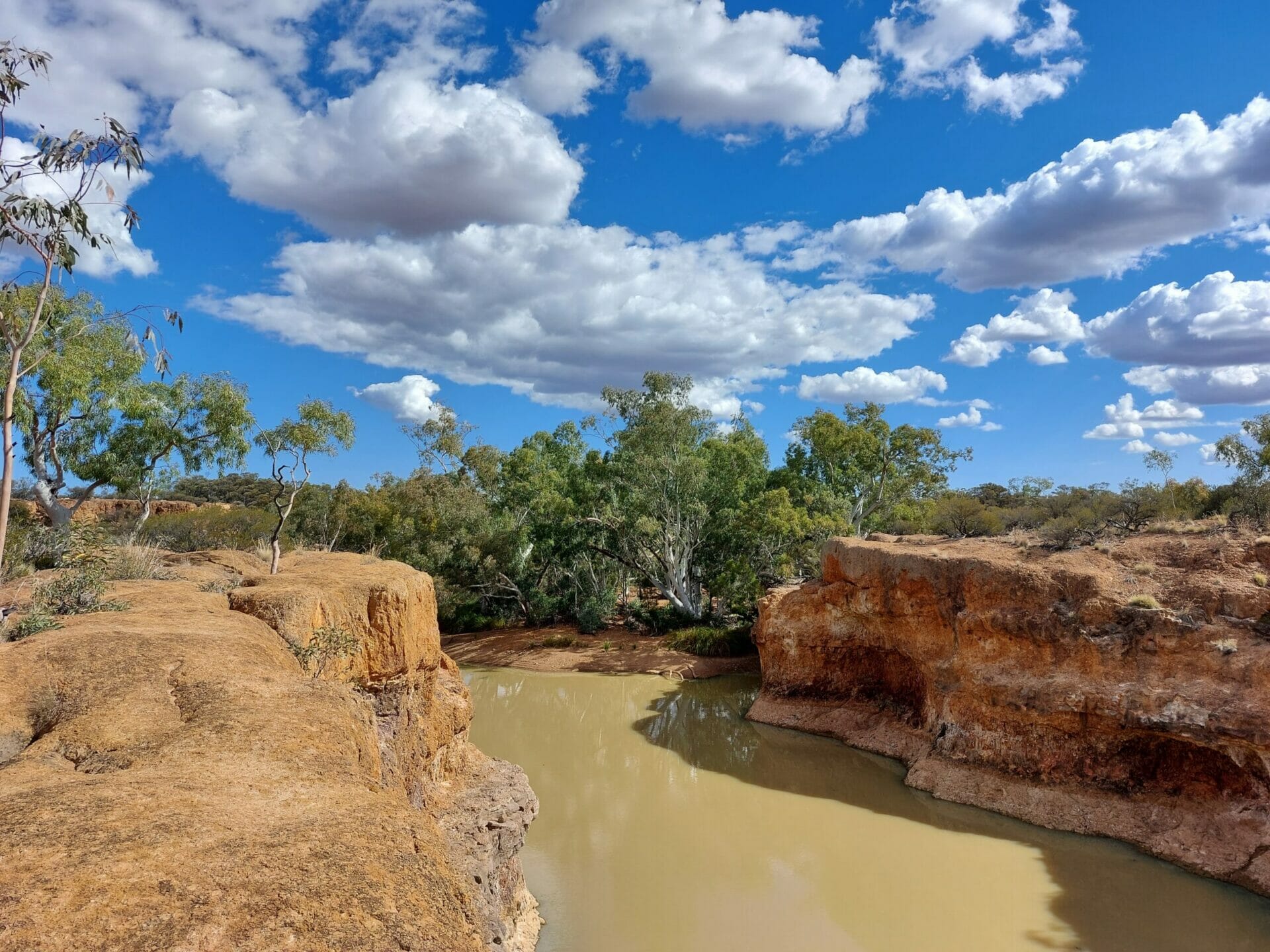
On our return journey, we took a detour to Spencers Waterhole which is about 1.2 kilometres from the main road. This is another stunning spot and we couldn’t believe how many turtles were in the waterhole. Spencers Waterhole is filled with fresh water each wet season via runoff from Spencers Creek.
ADAVALE, TOOMPINE AND CHEEPIE
Avadale
Avadale is the closest village to Hell Hole Gorge National Park. It has a great little pub. Or why not check out the amazing Elegant Emu where you can have High Tea in the bush?
Free camping is available at the Adavale Town Hall. The campground has toilets, showers and even power. It is pet friendly and also has Telstra phone reception.
Cheepie
is a ‘ghost town’ but once it was a Cobb & Co Change Station before the railway came to town in the 1900s. These days all that remains is the old Post Office and the old Railway station and sign.
Toompine
Toompine is the pub with no town.
All that remains of this once-thriving opal town is the Toompine Hotel. Although the pub is currently closed for renovations, it’s still a great spot to stop if you are keen on a spot of fishing.
Or why not try your luck fossicking for opals at Duck Creek and Sheep Creek Station Opal Mines? (Fossicking licences are required).

With years of experience travelling Australia in a caravan, I’m passionate about helping others embark on their own unforgettable adventures. From off-grid camping tips to expert advice on planning the ultimate big lap of Australia, I share stories, practical hacks, and inspiration to make your journey stress-free and exciting. Whether you’re a seasoned traveller or just starting out, join me as I explore the beauty of Australia, one road at a time!


